

Holiday Mindset: when your mind realises it’s December
In December, something happens that has nothing to do with decorations, panettone, or gift algorithms. That something happens in your head. Neuroscience refers to it as anticipatory cognition: as a transition approaches, the brain adjusts attention, motivation and perception of the surrounding environment. In wellbeing psychology, a related concept appears: the anticipatory relaxation response, when the body begins to slow down even before an actual break begins. This is what happens every year with the measurable, recurring holiday mindset: a slight detachment from routine that should not be read as distraction, but as a neurocognitive necessity. The mind settles in, much like that tree covered in baubles and lights in your living room.

When attention starts to drift
We stop noticing familiar details like the colleague speaking too loudly, and suddenly become aware of things we usually ignore: the muffled sound of the corridor, the sense of closure when we shut the laptop. This shift can be traced back to neurobiology. When the brain senses an approaching threshold, it cuts away the superfluous and sharpens its focus on what matters. December can therefore be seen as a selective month: it preserves what truly counts and leaves everything else with the promise of “we’ll pick this up again in January.” Paradoxically, this very selectivity is what makes the famous end-of-year rush feel more chaotic. We try to close every task, but the mind, already busy preparing for transition, no longer follows a straight line. It’s like working with a built-in Advent calendar: each day opens a small window, and a portion of attention drifts elsewhere.
The workplace, in soft focus
Observing a workplace at the end of the year becomes an interesting experiment in cognitive economy. Pauses grow more frequent, conversations lighter. These are gestures we adopt when something is about to end: we move through the final stretch with one foot in the present and the other already elsewhere. The workplace turns into a sequence of micro-phases, setting its own pace of movement and of thought.
This is December: a month in which the mind prepares the choreography, lightens the plot and rearranges the props. And when the moment finally arrives, we are already ready, without quite realising it. Ready for what? Well, for long meals at the table and watching Trading Places as if it were the very first time.
Behind the Scenes of the JPMS Project
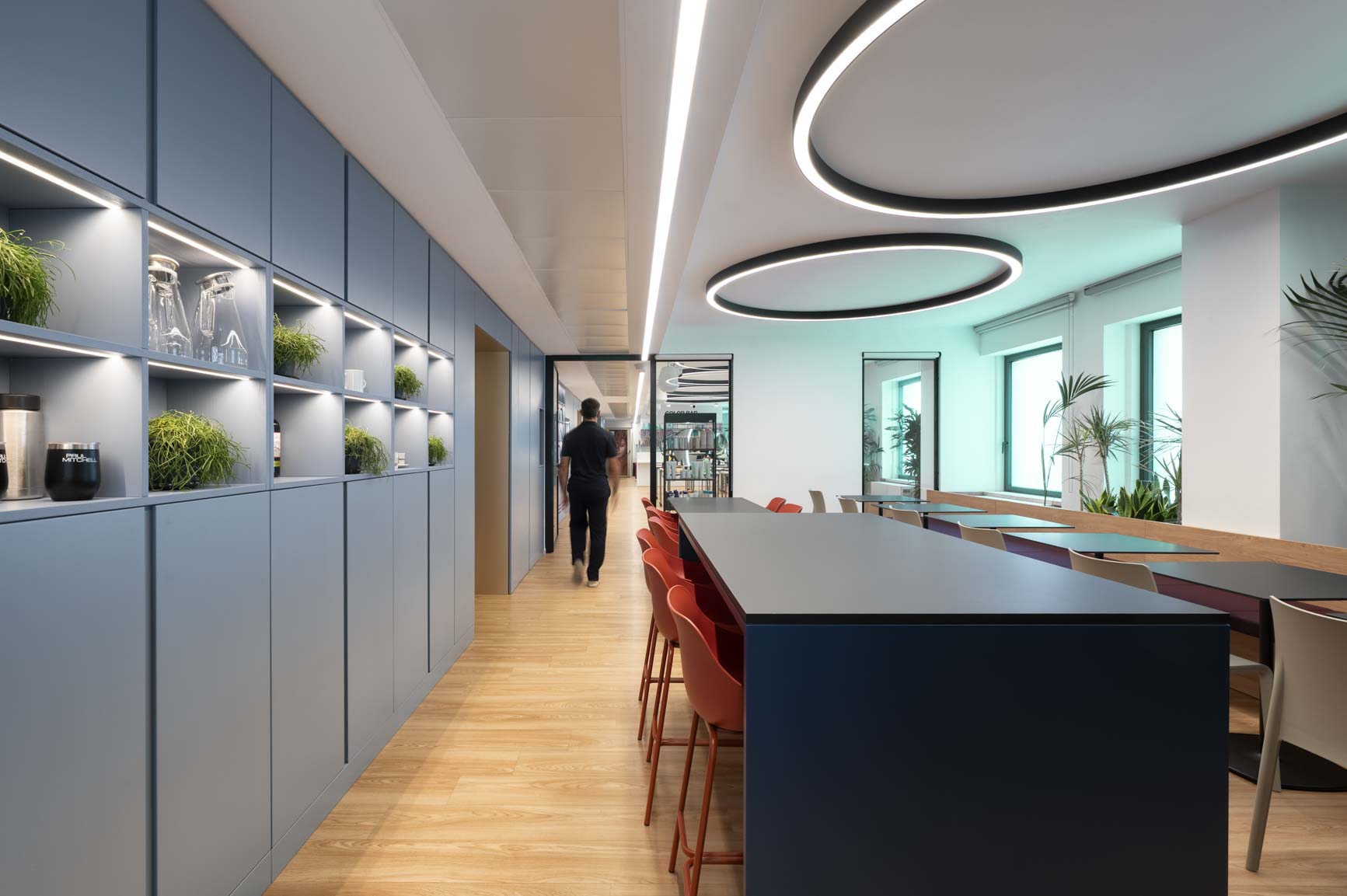
“JPMS was, first and foremost, an exercise in coexistence between two very different entities.”
This is how Isabella Ducoli, Head of Design at Altis, opens the story of JPMS’s new Rome headquarters, the Italian base of the international haircare group.
On one side, there was a training academy: courses for hairdressers, workshops, brand experiences, technical demonstrations. On the other, the operational offices: marketing and corporate teams.
“They asked us for a single space that could host two functions which, in reality, require very different atmospheres and cognitive logics, all within the same building.”
The challenges: a promising yet contradictory building
The building offered clear potential, thanks in part to its three independent entrances, but it also presented significant design challenges:
- a single set of restrooms, insufficient for two autonomous functions;
- a very deep central area that was difficult to organise;
- a core occupied by technical rooms and systems, filled with heterogeneous elements and visual discontinuities;
- two very different views: one wide and open onto the square, the other screened towards the internal courtyard.
“It was a beautiful but disordered space,” Isabella recalls. “There were many elements pulling in different directions. Our goal was to make them work together.”
Altis’ design strategy: three moves that work as a system
The first move was the most structural, as it concerned the very heart of the building: creating a second set of restrooms to allow the two functions, training and operations, to coexist without interference.
“The building was very deep: we needed a second core to give autonomy to the academy and the offices. It was a technical choice, but above all an organisational one.”
With this intervention, the two entities finally achieved a coherent spatial distribution.
The second move focused on organising the views and their use as the true design matrix.
“The view onto the square was extraordinary: light, depth, horizon. That’s where the offices had to be. The academy, on the other hand, didn’t need a panorama: what matters there are the products, the screens, the learning experience.”
To mitigate the less valuable view of the internal courtyard, Altis introduced a continuous system of integrated greenery, filtering the light and improving the perceptual quality of the showroom.
Finally, the most complex issue was the central technical core: irregular, visually chaotic, interrupted by doors, systems and signage. Isabella remembers it well:
“It was a point that desperately needed order. So we designed an element that wouldn’t be just aesthetic, but efficient.”
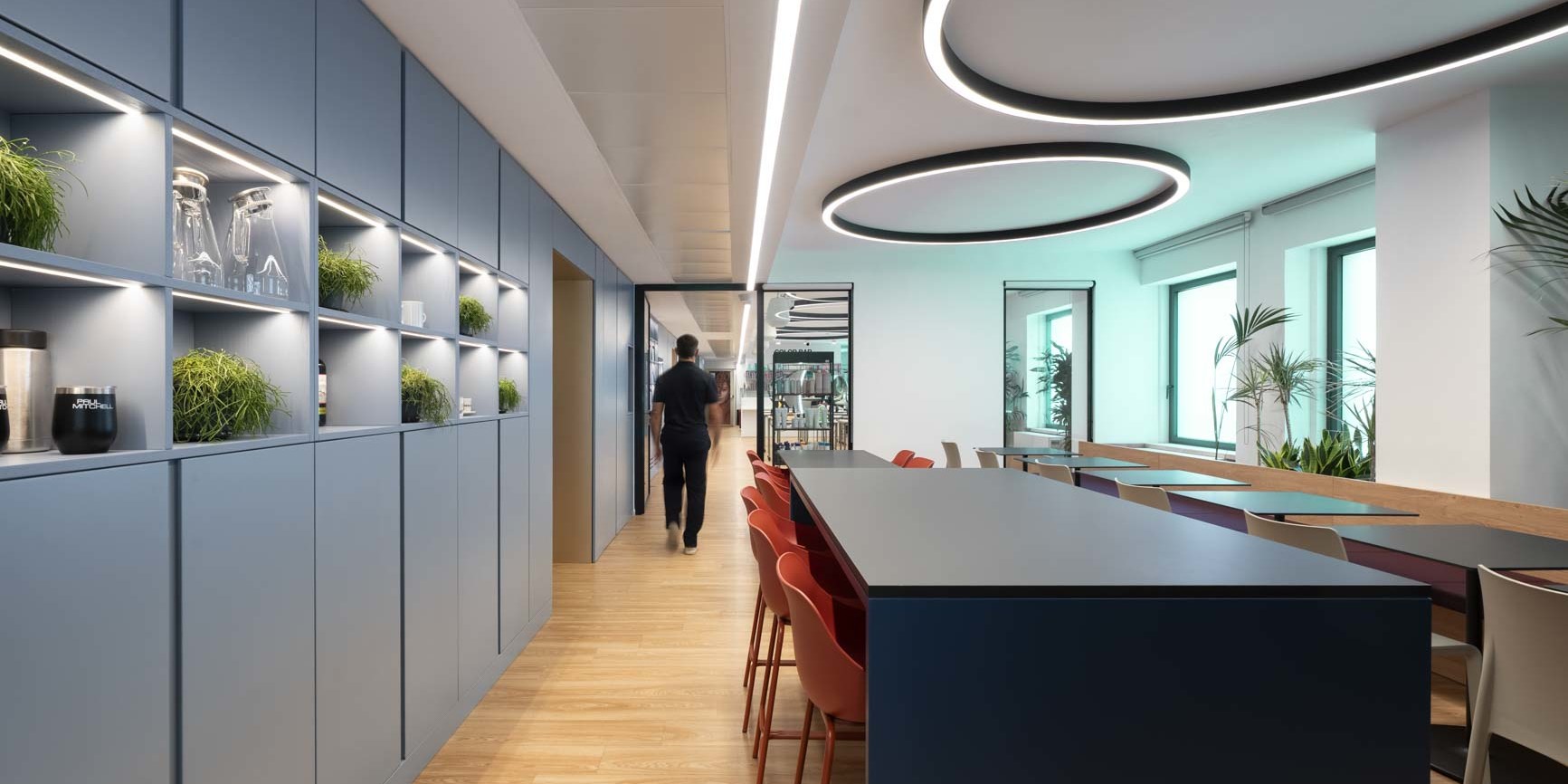
This led to the creation of the Brand Gallery: a single, full-height volume running along the perimeter of the core. A solution that:
- reorganises the core, concealing systems and discontinuities;
- works as continuous storage for both areas;
- opens at strategic points to become a true showcase for JPMS products;
- conceptually connects the academy and the offices, becoming a narrative and operational backbone.
“Everything was very fragmented. The gallery became the element that brought order and told the brand’s story.”
The result: a project that holds two worlds together
Today, JPMS is a coherent space where different functions, perceptions and rhythms coexist without conflict. It is a project that shows how the Altis method can turn constraints into structure, and how internal spatial narrative can transform a distribution problem into a strong design identity.
If you’d like to explore the right approach for your own space, write to us at [email protected].

Beyond Human-Centric: Designing for AI and the Machine Era
For years, we have designed spaces starting from the human perspective, considering posture, needs, emotions. And that is still the case.
But today, a new actor has entered the workplace: artificial intelligence. It does not replace people; it multiplies their interactions and alters their pace. We are no longer alone in the room. There are now two of us: an emotional mind and an algorithmic one, operating according to very different temporal and functional logics. And this, inevitably, has a design impact. So the question becomes: what happens to space when two different intelligences coexist within it?

From the labs of the future to today’s desks
This is a topic also explored by Gensler in its research on “next labs”. From biotech to robotics, laboratories are becoming hybrid environments: automated processes alongside human decision-making, real-time data reshaping workflows, ecosystems of different intelligences sharing the same operational space. What is happening in labs today will happen in offices tomorrow.
This is where the Altis method finds a crucial role: reading the interplay between behaviours, processes and spaces, and translating it into a project that favours neither the machine nor the person, but the relationship between the two.
Designing for a dual intelligence
Here are the new design elements that come into play when creating environments where different speeds can truly coexist:
- Cognitive buffers Spatial interfaces that regulate the flow of information between humans and machines: transition rooms, decision-settling zones, areas where automation can slow down in favour of human judgement.
- Thresholds of attention Paths that separate moments of high computational intensity from moments of high emotional intensity. AI signals, suggests, predicts; humans integrate, evaluate and modulate.
- Asynchronous rhythms Spaces designed for work that no longer follows a single temporal metric: biological time (pause, posture, rest) alongside algorithmic time (continuous calculation). Design must harmonise these cycles, preventing overload.
- Human interfaces Areas where technology does not dominate but converses: screens that inform without overwhelming, predictive systems that do not interrupt, environments where the digital remains legible and governable.
The Altis method as mediator
When processes become hybrid and decisions move across two frequencies, a clear design posture is required. With its three-step Method Consult, Design, Deliver, Altis provides a framework to govern this coexistence. An approach that protects the human dimension by translating complexity into an ecosystem that is coherent, readable and inhabitable. Because as work accelerates into the virtual and AI-driven realm, the collective dimension tends to thin out. Physical space then becomes the necessary counterpoint: the place that reminds us that, in order to function, we still need one another.
If these reflections resonate with your workplace, write to us at [email protected]. Some conversations deserve to take shape.