

“JPMS was, first and foremost, an exercise in coexistence between two very different entities.”
This is how Isabella Ducoli, Head of Design at Altis, opens the story of JPMS’s new Rome headquarters, the Italian base of the international haircare group.
On one side, there was a training academy: courses for hairdressers, workshops, brand experiences, technical demonstrations. On the other, the operational offices: marketing and corporate teams.
“They asked us for a single space that could host two functions which, in reality, require very different atmospheres and cognitive logics, all within the same building.”
The challenges: a promising yet contradictory building
The building offered clear potential, thanks in part to its three independent entrances, but it also presented significant design challenges:
- a single set of restrooms, insufficient for two autonomous functions;
- a very deep central area that was difficult to organise;
- a core occupied by technical rooms and systems, filled with heterogeneous elements and visual discontinuities;
- two very different views: one wide and open onto the square, the other screened towards the internal courtyard.
“It was a beautiful but disordered space,” Isabella recalls. “There were many elements pulling in different directions. Our goal was to make them work together.”
Altis’ design strategy: three moves that work as a system
The first move was the most structural, as it concerned the very heart of the building: creating a second set of restrooms to allow the two functions, training and operations, to coexist without interference.
“The building was very deep: we needed a second core to give autonomy to the academy and the offices. It was a technical choice, but above all an organisational one.”
With this intervention, the two entities finally achieved a coherent spatial distribution.
The second move focused on organising the views and their use as the true design matrix.
“The view onto the square was extraordinary: light, depth, horizon. That’s where the offices had to be. The academy, on the other hand, didn’t need a panorama: what matters there are the products, the screens, the learning experience.”
To mitigate the less valuable view of the internal courtyard, Altis introduced a continuous system of integrated greenery, filtering the light and improving the perceptual quality of the showroom.
Finally, the most complex issue was the central technical core: irregular, visually chaotic, interrupted by doors, systems and signage. Isabella remembers it well:
“It was a point that desperately needed order. So we designed an element that wouldn’t be just aesthetic, but efficient.”
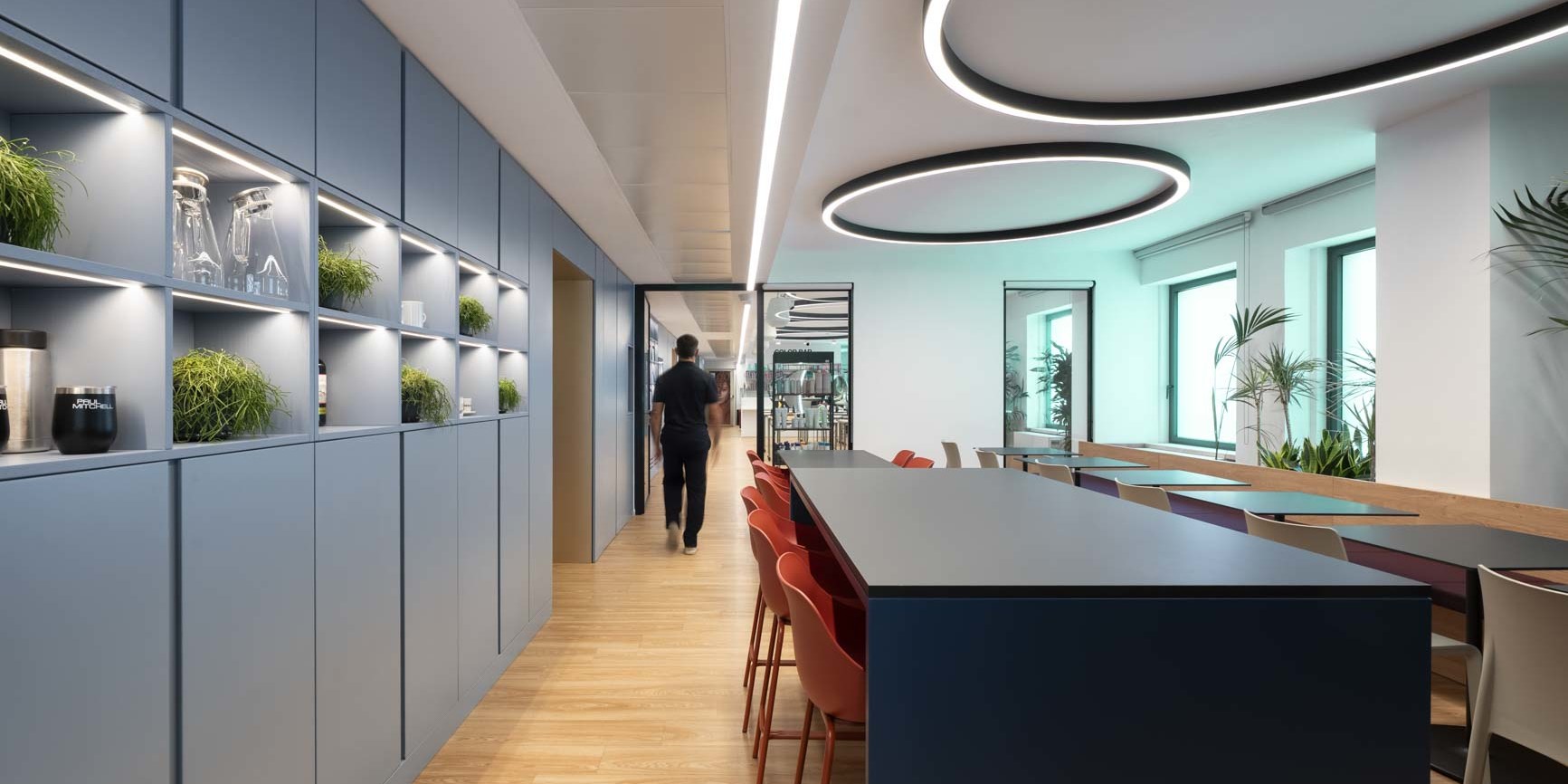
This led to the creation of the Brand Gallery: a single, full-height volume running along the perimeter of the core. A solution that:
- reorganises the core, concealing systems and discontinuities;
- works as continuous storage for both areas;
- opens at strategic points to become a true showcase for JPMS products;
- conceptually connects the academy and the offices, becoming a narrative and operational backbone.
“Everything was very fragmented. The gallery became the element that brought order and told the brand’s story.”
The result: a project that holds two worlds together
Today, JPMS is a coherent space where different functions, perceptions and rhythms coexist without conflict. It is a project that shows how the Altis method can turn constraints into structure, and how internal spatial narrative can transform a distribution problem into a strong design identity.
If you’d like to explore the right approach for your own space, write to us at [email protected].